
Training Workshop for School Leaders and Education Officials on GCED in Cambodia

Updated: Sep 12, 2025
In June 2025, the Cambodia Global Citizenship Education Cooperation Center (GCC-Cambodia) hosted a global citizenship education training workshop, during which I delivered sessions on Korea’s practices in GCED.
Note: The Cambodia Global Citizenship Education Cooperation Center(GCC-Cambodia) was established in 2022 through a collaboration between UNESCO Asia-Pacific Centre of Education for International Understanding (APCEIU) and Cambodia’s National Institute of Education (NIE). The center plays a core role in Cambodia in both the development and implementation of global citizenship education policies. As of 2025, APCEIU has designated and operates cooperation centers in eight countries—namely, the Philippines, Thailand, Indonesia, Nepal, Malaysia, Bangladesh, and Laos—in addition to Cambodia, to support more effective implementation of global citizenship education.

GCC-Cambodia Training Workshop
The three-day training, held from June 5 to 7, was attended by officials from the Cambodian Ministry of Education, local education offices, and principals of high schools designated as GCED research schools. The main focus was on discussing how GCED can be implemented in Cambodian schools.
Two sessions under the title “Korea’s Approach to Global Citizenship Education: From Policy to Classroom” covered: (1) the current state of global citizenship education in Korea focusing on policies and institutional frameworks and (2) the practical implementation of GCED in schools. While presenting concrete cases of Korean practices in GCED, I tried to encourage participants to consider how these approaches might be applied in the Cambodian context. Sharing examples from specific countries or situations can be meaningful, but it's essential to design sessions from the perspective of the participants - those who would later be applying these insights. No matter how exemplary a case may be, it cannot be directly transplanted into another context. Therefore, it's important to identify and present points of insight, possible adaptations, and connective threads that can link differing contexts.

Session 1 Highlights
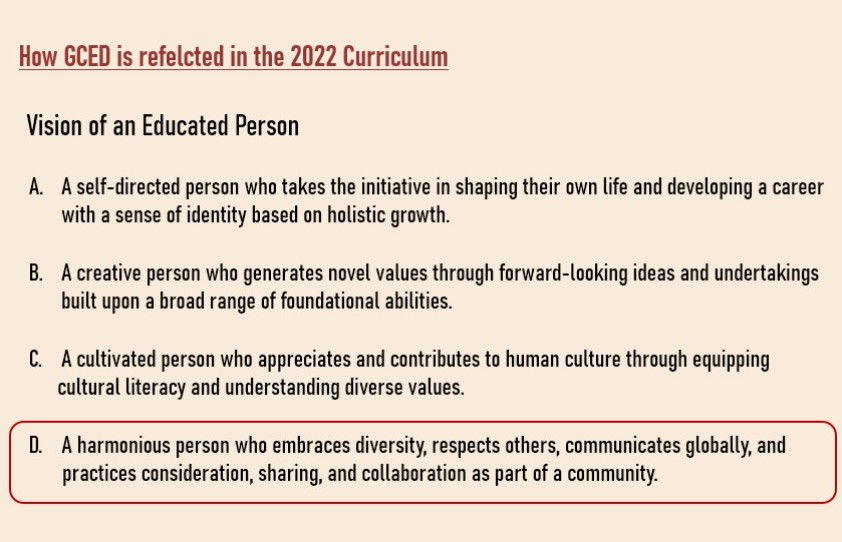
The first session began by exploring how Korea's national curriculum integrates GCED, and proceeded to introduce some GCED initiatives, including GCED Lead Teachers program with its outcomes and impact. It also showcased how various provincial and metropolitan education offices address GCED through their policies and tailored programs. Given that educational reform is currently underway in Cambodia, many participants were interested in embedding global citizenship values or components into the national curriculum. Yet, they also expressed curiosity about how precisely GCED might be framed as specific "content" or "themes" within the curriculum. While the cascade-approach is a familiar model for teacher training and policy roll-out in many countries, it is less common in the field of GCED. Participants were particularly interested in its effectiveness, especially considering it has been sustained in Korea since 2015 for over ten years.

Session 2 Highlights
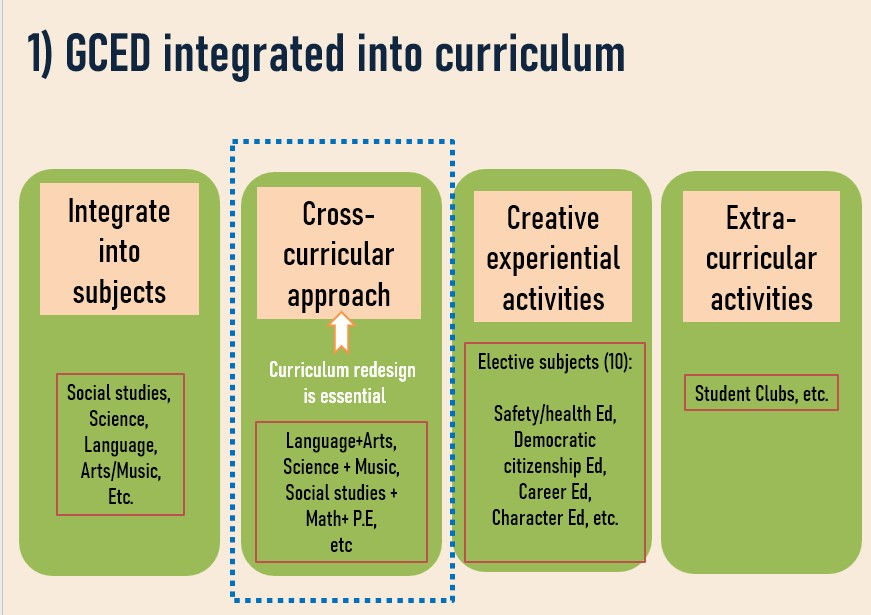
The following day’s session addressed step-by-step integration of GCED into school curriculum, whole-school approaches and cross-subject instruction, community-linked practices, and pedagogical strategies for GCED.
Much like in Korea, many Cambodian schools—especially given that participants were high school principals—find it impossible to teach GCED as a standalone subject due to already packed schedules and multiple subject demands. Integrating GCED into existing lessons is also challenging in many respects. Particularly, restructuring school curriculum requires teachers to have sufficient capacity and it takes time. However, opportunities for teacher training are limited, and even when training is provided, there are concerns around the availability of suitable resources and methods. Participants showed strong interest in curriculum redevelopment and agreed that how GCED is delivered is just as significant as its content. They expressed a desire to learn more about diverse pedagogical approaches. In the session featuring case presentations from the Cambodia GCED Cooperation Center, examples of integrating UNESCO's GCED Teaching and Learning Objectives (TLO) into Cambodian secondary school subjects were shared. This sparked lively discussion and questions, making it a valuable learning experience for me as well.

Post-Workshop Ideas and Reflection
After the workshop, participants who had been given missions to implement GCED in their regions and schools shared their ideas for future practice. Suggestions ranged from integrating GCED into social studies and ethics classes, to incorporating themes such as sustainability or respect for diversity into Khmer language, chemistry, or mathematics lessons. Given that participants were high school principals - similar to Korea’s school principals - it was impressive to learn about their plans not only for subject integration but also for embedding GCED into their schools’ curricula, school management, and annual school plans. This suggests promising potential for future grassroots implementation.

However, persistent challenges were raised, including lack of resources, limited teacher capacity and expertise, questions regarding sustainability, and realistic constraints in Cambodian schools-where many teachers cannot invest in professional development due to low compensation, teachers often hold non-teaching jobs, there is a scarcity of qualified teachers, basic teaching materials are lacking, and overlapping educational/development agendas result in many one-off projects.
Considering Cambodia’s historical and social context, it is crucial that stakeholders—including government officials, teachers, domestic and international partners, community members, and experts – collaborate discussing how GCED’s values based on human rights, critical perspectives, social transformation, and civic engagement can be interpreted and effectively delivered in Cambodian educational settings. It is necessary to develop tailored Cambodian approaches to GCED that best fit the country’s contexts.
You may want to read the article on the workshop by APCEIU here.

Comments